
From “we should use AI” to a task worth starting with
Pick a recurring task, such as preparing a customer proposal. Define what a useful result looks like, how long the task takes today and what would make the pilot worth continuing.
AI3 · AI Transformation for Business Leaders
You bought a premium ChatGPT subscription. You ask about your business and still get generic answers. Make AI produce work your team can actually use.
Your business has work AI could help with. Learn where to start, what company information to give it and how to connect the steps. Build a knowledge base, a useful application and an agent workflow on a fictional company, then adapt them to yours.
6 practical sessions × 3 hours. 18 hours in total.Strategy. Data. Applications. Agents. Governance. Adoption.
Cohort dates and enrollment details to be announced.
@@ Not for @@
@@ Who it is for @@
The shared case
The same fictional B2B company runs through the whole program. You work with its business priorities, documents and processes as you move from strategy and data to applications, agents, operating controls and adoption.
Everything you build is designed to be reused in your own company. You take the methods, templates, knowledge base, application and agent workflow with you, then adapt them to your own data, systems and processes. The fictional company is a shared starting point; your own company is where you put the results to work.
{ The program }
01 — 06
3 hours per session
AI-Ready Company
Assess how ready the case company is for AI. Find opportunities, compare their expected value and delivery effort, and identify the dependencies that could stop them. Define the baseline, assumptions and success measure before choosing what to build.
You leave with: a prioritized opportunity map, a first business case with explicit ROI assumptions, and the first version of your AI transformation roadmap.
AI Data Foundation
Map the data, documents and systems behind the chosen process. Explore how data architecture, a semantic layer and retrieval-augmented generation help AI work with company information. Build a small knowledge base from the case documents and check its answers against the source material.
You leave with: a working knowledge-base exercise, an initial answer-quality check, and a map of the data sources, access requirements and gaps your use case depends on.
AI Builders
Map the process and decide where an application would help. Compare building with adapting an existing solution, then create a small prototype. Explore how skills, plugins, MCP and CLI tools connect AI to useful actions, and identify the integrations and deployment work your company would need.
You leave with: a functional prototype for a bounded business task and a list of the integration and deployment requirements for taking it further.
Agentic Enterprise
Extend the case into a multi-step workflow. Decide which steps should follow fixed rules, where an AI agent adds value and where a person must approve an action. Test a failure case, inspect the execution log and examine the tradeoffs between quality, speed and cost.
You leave with: a working agent-assisted workflow for the case, explicit human checkpoints, and an initial evaluation and monitoring checklist.
AI Governance
Review the prototype's data access, permissions, failure modes and ownership. Map the questions raised by GDPR and the EU AI Act that need review in your organization. Define approval, logging, monitoring and escalation requirements, including when the system should stop and hand work to a person.
You leave with: a deployment-readiness plan, a risk register and named responsibility areas to resolve with your security, legal and operational owners.
AI Adoption & Transformation
Plan how people will learn, use and improve the new process. Define the role of AI champions, internal training and knowledge sharing. Connect adoption measures to the business baseline, set criteria for expanding the pilot, and complete the transformation roadmap with owners and dependencies.
You leave with: an AI transformation roadmap for your organization, including the first pilot, responsibilities, success measures and conditions for scaling.

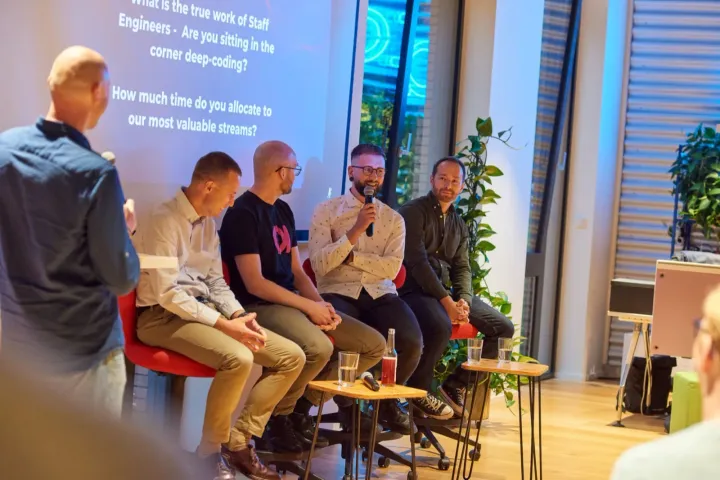
From the Engineering Leaders community
Before → After
Pick a recurring task, such as preparing a customer proposal. Define what a useful result looks like, how long the task takes today and what would make the pilot worth continuing.
Ask a question about the case company’s services or internal procedures. Get an answer based on its documents, with sources you can check, and test what happens when the information is missing.
Use a customer brief to retrieve relevant company information and prepare a proposal draft. Check the draft before anything is sent, and reuse the workflow on the next brief.
Define who checks facts and pricing, which information AI can access and when a person must approve the next step. Know what to do when the output is wrong.
Take the workflow back to your company with a plan for your data, systems and team. Name the owner and decide how you will compare the result with the way the work is done today.
The takeaways
You keep everything you create during the program. The methods, templates and working prototypes are reusable foundations for your own company. Your roadmap identifies how to adapt them to your data, connect them to your systems and put them into use.
Why this format
01
The problem you prioritize in session one is the problem you carry through data preparation, prototyping, automation and operating requirements.
02
You build and inspect working examples so you can ask better questions, assess proposals and understand the tradeoffs behind an AI initiative.
03
Information access, answer quality, permissions and human responsibility shape the solution as it develops.
04
The final roadmap draws on your business case, practical exercises and operating decisions. It shows what is ready, what remains uncertain and what needs to happen next.
Format
Questions
AI1 develops your own ability to get useful work done with AI. AI2 focuses on adoption across teams. This proposed AI3 program connects business priorities, company data, applications and agents into a process you can evaluate and plan to operate.
The proposed entry point is equivalent practical experience: you already use AI for real work and can assess its output. The program builds on that foundation rather than teaching basic prompting.
We build on the shared fictional company, but everything is designed for reuse in your own organization. You leave with the methods, templates and working prototypes, plus a roadmap for adapting them to your context. Connecting them to live company systems requires the relevant access and approvals.
You leave with working workshop prototypes and an explicit plan for what deployment requires. Production readiness depends on your company's integrations, security controls, validation and operational ownership.
The scope is a small knowledge base, a bounded application and an agent-assisted workflow within one case. The aim is to understand the whole path and make informed decisions about the next implementation.
AI3 · AI Masters
Bring that task. Learn how to give AI the information and workflow it needs to help, then leave with reusable examples and a plan for trying it in your company.
Dates, instructors and pricing will be confirmed before enrollment.